


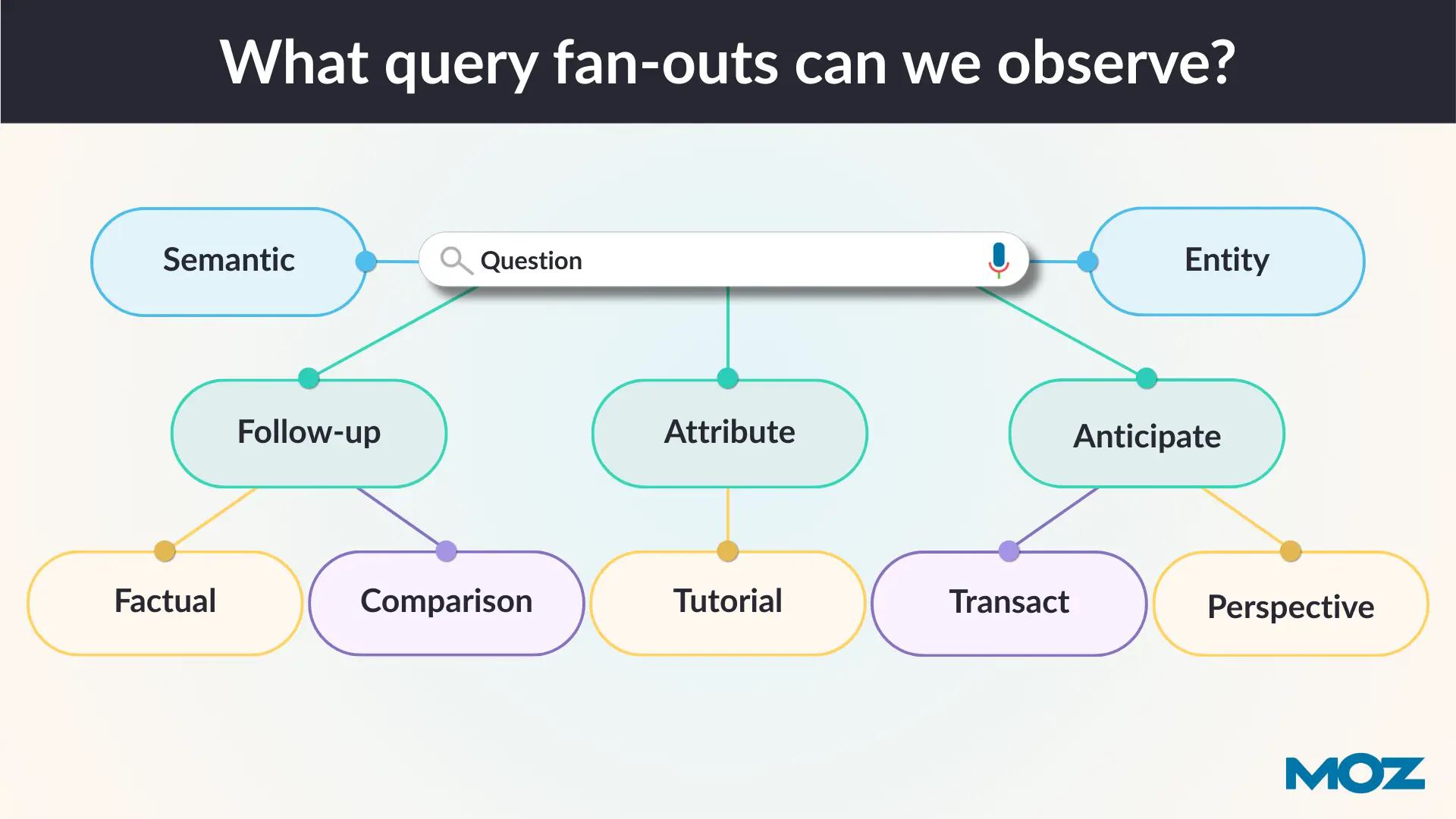
Last year, we published a framework for understanding query fan-out based on 10 fan-out types representing observed Google results (primarily from Web Guide Beta):
To take this work to the next level, we need reliable, repeatable prompts and metric, not just anecdotal evidence. Over the past few months, I set out to build a prompt-generation laboratory and dataset of 1,000 subtopics and 50,000 fan-out prompts.
Today, I’d like to share that data set and the insights we’ve gained from it. While this dataset was designed to improve our fan-out model, it’s already taught us a lot about how brands overlap with intent, measuring relevance, and the evolving long-tail of search.
1. Brands are powerful, but intent matters
In our early attempts at generating query fan-out prompts, any mention of brands or competitors heavily influenced LLMs to put brand terms in the fan-outs. If a brand is in the prompts, odds are nearly 100% that it will be mentioned in the LLM response, introducing a massive amount of bias.
For the 50k data set, we generated one primary brand and two competitors for each of the subtopics and used them as contextual hints in the prompt. Think of it as a nudge instead of a command – a distinction that can make a huge difference with LLMs.
In the latest analysis, 12.8% of generated prompts contained a mention of either the primary brand or one of the two competitors. Here’s where it gets a lot more interesting. Look at the top five fan-out types that generated the most brand mentions:
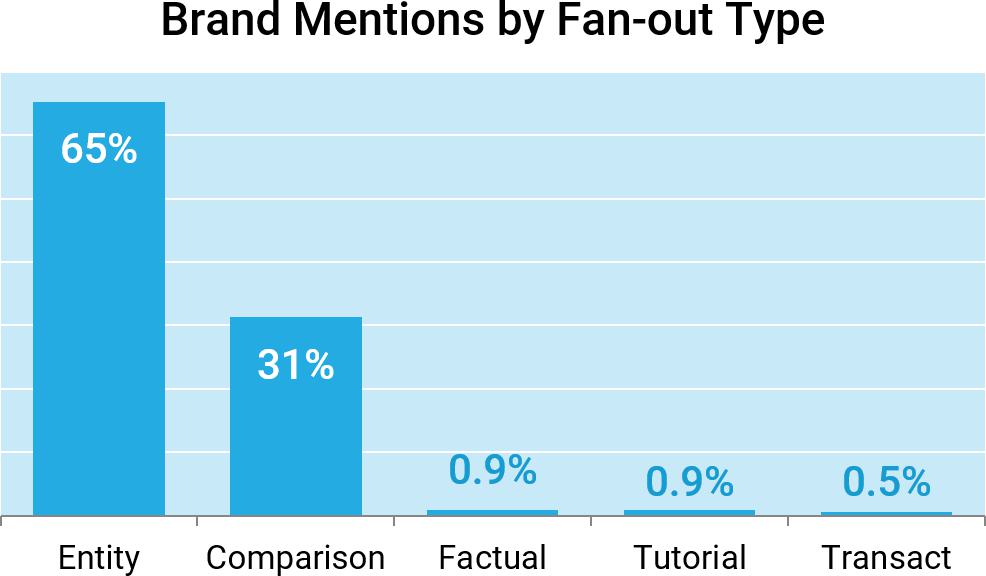
Just two fan-out types accounted for 97% of brand mentions. Brand mentions in [Entity] fan-outs aren’t shocking – brands are, after all, entities – but [Comparison] fan-outs have a strong brand component. Anything after second-place is almost irrelevant.
While our current prompt-generation logic is generally designed to suppress brand mentions in the prompts themselves, the overlap of fan-out intent and brand visibility is undeniable. Brand mentions aren’t random – they’re heavily biased by the types of prompts we choose to track.
2. Fan-outs were topical but not *too* relevant
Fan-out prompts should align strongly with the topic, right? Well, yes, but we don’t want every fan-out to be a minor variation on the topic, shuffling around a couple of words (and neither does Google). We want useful, diverse fan-outs that are also relevant.
To measure relevance, we tried a few things, but landed on what I’ll call "Alignment" – the cosine similarity of the fan-out prompts to their subtopic (note: we converted each subtopic into a question in the form of "What is [subtopic]?").
Alignment scores for this data set ranged from 0.22–1.00, with a mean score of 0.67. Generally speaking, the scores were well-distributed across the 50k prompts:
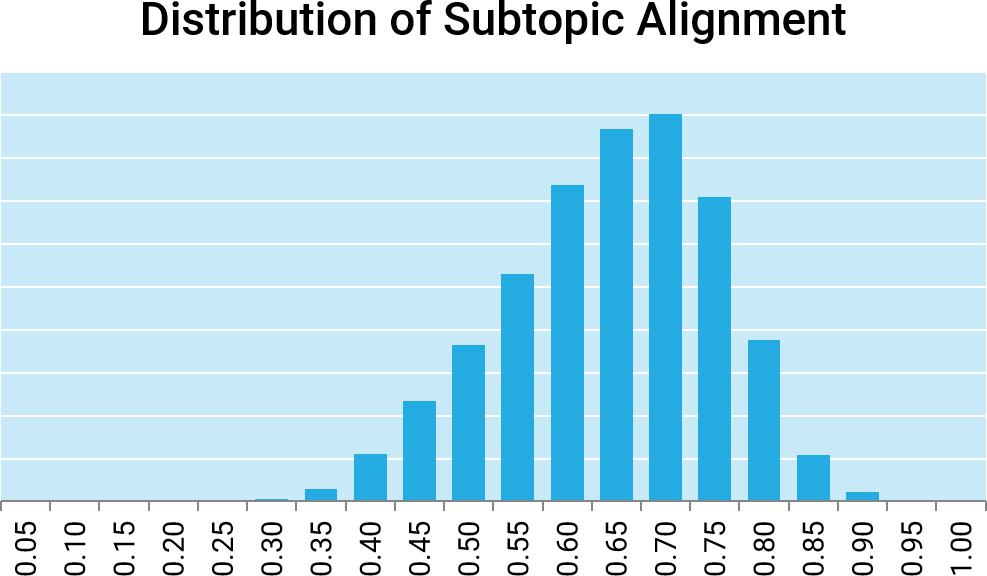
Cosine similarity scores can be a bit hard to interpret, so let’s put this into context. Consider the following Alignment scores, subtopics, and fan-out prompts:
- 0.22 = Cloud Storage Services / How to share a private link to a file.
- 0.67 = LED Light Therapy / How to use an LED mask for best results.
- 0.90 = Data Privacy Compliance / How to ensure data privacy regulatory
- 1.00 = Software Asset Management / What is software asset management?
Even a 0.22 is topically relevant, but is getting out toward the edges, and doesn’t mention any of the terms in the subtopic. Meanwhile, a 0.90 is clearly on-topic and also contains most of the keywords in the subtopic.
So, what’s a good Alignment score? It’s a bit subjective, but ultimately we want relevance to the subtopic without matching it so rigidly that every fan-out prompt is the same. In other words, we want to balance topical alignment with fan-out diversity. In this case, I think our mean score of 0.67 represents a good balance. We’ll call it a win.
3. Fan-outs cluster in the medium-long-tail
Once we move from topics to questions, whether in organic search or LLMs, we naturally move deeper into what SEOs would typically call the long-tail. Our fan-out prompt-generation logic aims at a maximum of 12 words, and the dataset averages 8.2 words per prompt (with a range of 3-13, so it behaved reasonably well).
What does an average (roughly 8 words) prompt look like? Here are a few:
- “How to conduct an effective tenant exit interview”
- “Where to find affordable beginner golf club sets”
- “Why do customers leave brands they once liked?”
How long should a fan-out prompt be? We’re collecting search-grounding data from Gemini as we speak, but our goal is to keep the prompts long enough to be specific but broad enough that targeting them could cover many variations. Humans might write paragraphs in Gemini or ChatGPT, but marketers can’t track them all.
It’s interesting to note that Gemini itself, given a maximum of 12 words, settled on an 8.2-word average. So, that tells us something about the prompt length we need to generate interesting fan-outs from topics and subtopics.
What’s in the dataset?
We wanted a consistent dataset covering a wide range of topics. We also wanted a quantity of fan-out prompts that was big enough to be interesting, but not so big that it would be cumbersome to re-evaluate frequently. Here are the basics:
- 20 industry verticals (via Google Trends, etc.)
- 1,000 subtopics (via Gemini Flash) = 50 per vertical
- 50,000 generated fan-out prompts = 50 per subtopic
- 5,333 grounding queries from Gemini API
From each subtopic, we used our proprietary fan-out approach to generate 5 instances of each of the 10 fan-outs (so, 50,000 = 1000 x 5 x 10). We also used Gemini to suggest one primary brand and two competitors for each subtopic.
All of the data here was generated with the Gemini API, running Gemini 3.1 Flash Lite, except for grounding queries, which used Gemini 3.5 Flash (more on that later).
Free data (topics, fan-outs & metrics)
We’re sharing all of the raw data with our readers in hopes of driving more conversations about query fan-out and how it impacts keyword research and prompt research in the GenAI era. We’d love to hear your insights and how you put the data to work!